
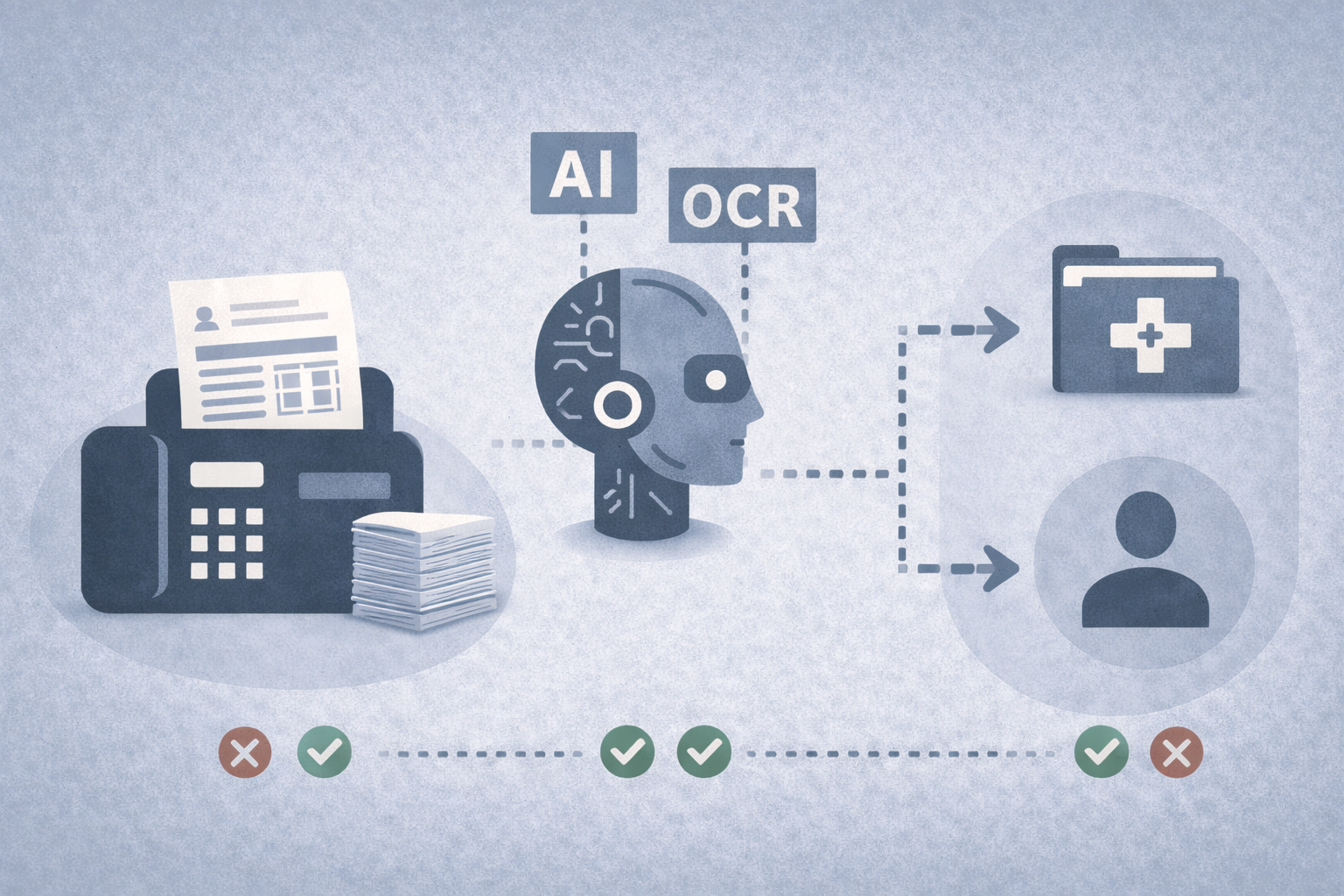
Most incoming faxes eventually become structured data in downstream systems. Data capture tools have used AI and machine learning for many years, but large language models have greatly improved accuracy and reduced intermediate steps in capture workflows.
Fax persists in regulated environments—such as healthcare, insurance, and public administration—because it’s secure, auditable, and accessible to nearly all counterparties.
What has changed is the expectation that fax data should move directly into downstream systems without manual sorting or re-entry. AI fax routing closes that gap by converting fax images into structured data and routing documents based on content rather than inbox rules alone.
Traditional fax platforms use OCR and rule-based logic to extract text and route documents. This works well with consistent layouts and predefined field locations. But consistent formats can’t always be taken for granted. Intelligent capture adds contextual analysis, which improves accuracy when formats vary or data appears in unexpected positions.
When a fax arrives, the AI capture software cleans the image, extracts text, identifies document type, and isolates key fields. If routing isn’t clear from business rules alone, the software then uses the document’s content to route it appropriately—similar to how a human operator would approach it.
Intelligent capture combines image preprocessing, OCR, document classification, entity extraction, and routing logic into a single intake pipeline.
When a fax arrives, the system:
Routing decisions rely on both defined business rules and document context. For example:
Header data and document metadata still contribute, but document content drives routing when formats vary too much for deterministic routing.
High-confidence decisions move directly into queues or downstream systems, while lower-confidence results move to review. Every classification, routing action, correction, and delivery event is logged with timestamp and user context.
Human corrections feed back into the model, improving recognition of recurring templates and sender patterns over time.
Intelligent routing benefits environments where fax volume is high and document variability is significant.
In each case, the value comes from reducing manual triage while preserving routing accuracy.
Ideally, AI fax routing operates inside the same secured and audited environment as the fax platform. That means:
Unreadable or ambiguous faxes must trigger defined fallback paths, including resubmission or manual review.
Governance should define how routing logic changes, how taxonomy updates occur, and how model refinements are approved.
Routing succeeds when it reflects real operational decision paths. Start by documenting how staff determine document type and destination. Identify the fields that drive those decisions, such as identifiers, provider data, payer details, dates, or internal codes.
Then:
Consider how confidence thresholds dictate automation levels. One common approach is automatic routing for higher confidence, manual review for medium confidence, and an exception-handling queue for low confidence (typically one-off documents or exceptionally distorted images).
When you move from proof of concept to production, select exactly one high-friction workflow for the pilot. Early testing often builds confidence, and teams may feel pressure to expand quickly. However, launching multiple workflows at once introduces too many variables: different document types, routing rules, exception patterns, and stakeholder groups. That complexity makes it difficult to isolate performance issues or measure true impact.
Instead, validate one workflow thoroughly. Confirm sustained improvement in turnaround time, routing accuracy, and exception rate across a meaningful sample size. Expand scope only after those gains prove stable and repeatable.
Once performance stabilizes, expand gradually to adjacent document types or workflows. As scope increases, engage operational stakeholders early and incorporate their feedback into routing logic and taxonomy updates. Train staff on exception handling and metadata correction so human review strengthens the system rather than slowing it down.
We can’t overstate the importance of involving stakeholders as early as possible. Initial wins build momentum and buy-in, and early course-correction prevents issues from snowballing.
Maintain documented governance for routing rules, confidence thresholds, and model updates. This starts before launch and continues for the life of the solution. Regular review keeps the system aligned with how work actually moves through the organization and prevents drift as workflows evolve.
AI fax routing delivers meaningful gains when organizations target their most problematic intake processes and measure performance rigorously. Concentrated deployment leads to faster processing, fewer misroutes, and clearer operational accountability.
If you want to evaluate whether AI-based fax routing makes sense in your environment, Paperless Productivity® can review sample traffic, validate capture accuracy, and outline a low-risk pilot tied to real workflows.
Please contact us today to discuss your workflow goals with a senior solutions architect.