
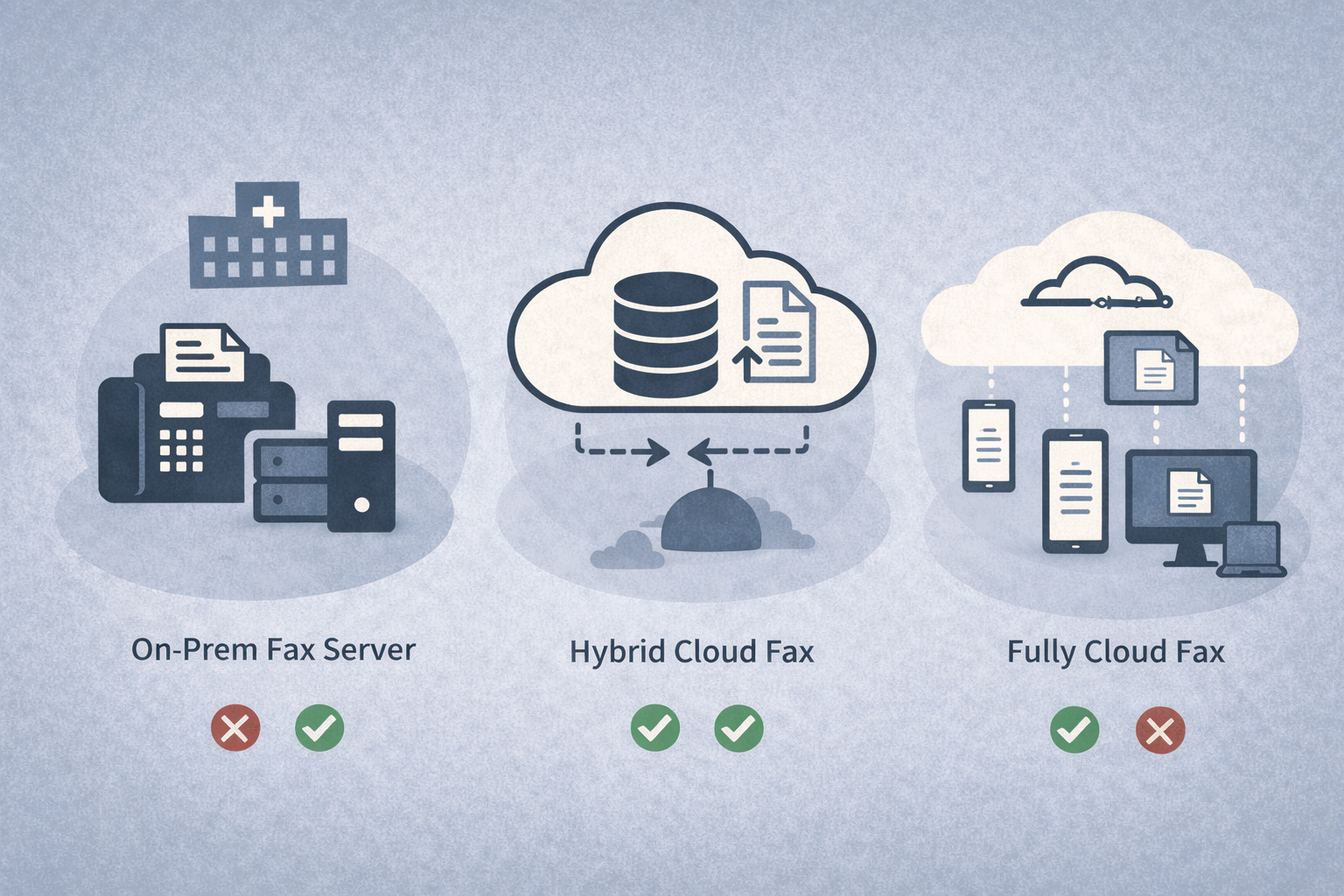
In 2026, treat fax as key architecture, not a utility. Here’s how the three main enterprise fax architectures compare:
None of the three enterprise fax architectures is universally superior. What’s efficient and straightforward for one organization may be cumbersome and costly for another.
Decision criteria usually come down to:
An on-prem fax server places the entire platform inside the organization’s infrastructure. The customer owns servers, telephony, patching, monitoring, logging, and disaster recovery. This model supports deep EHR integration, complex routing rules, legacy desktop workflows, and granular authentication control. It also requires internal telecom and platform expertise. Every outage, carrier issue, and upgrade remains the organization’s responsibility.
Public cloud fax shifts infrastructure to a multi-tenant SaaS provider. Deployment is fast and infrastructure ownership disappears. Basic send-and-receive workflows work well in lower-complexity environments. However, these platforms typically standardize workflow logic and abstract telephony details. Customers often have limited visibility into retry behavior, carrier interaction, and detailed audit controls. For modest volume and light integration, this trade-off may be acceptable.
A private cloud service deploys fax server software to a dedicated, single-tenant environment operated by a managed service provider. (Our Private Fax Cloud®, for instance, is built around the OpenText Fax engine, formerly known as RightFax). The client retains deep integrations, routing logic, and detailed audit capability. The provider manages infrastructure, telephony coordination, patching, monitoring, and failover. This model reduces operational burden while preserving enterprise-grade flexibility.
Compliance requires evidence, not just assurance. Organizations must show how fax systems enforce access controls, retain data, log activity, and recover from failure. They must also proactively review those records for signs of inappropriate PHI management. (Proactive review is often the biggest gap, as noted in a major 2017 enforcement action.)
A more detailed breakdown of auditability, access control, retry behavior, and security is available in our Private Fax Cloud FAQ.
Public-cloud SaaS fax offers email-to-fax, user portals, and typically a REST API. Enterprise-oriented vendors also integrate with certain EHRs and other major applications. Deeper clinical or legacy desktop integrations often require custom development or operational workarounds.
On-prem and private cloud fax support the deepest integrations: EHR connectors, dozens of back-office and line-of-business applications, print workflows, MFPs, directory services, and complex routing rules. Some also support older technologies like COM APIs. Some environments also support older integration methods such as COM APIs. Organizations with layered clinical or back-office workflows often need this level of flexibility.
Fax architecture determines how the fax engine interacts with the carrier and who sees and resolves failures.
On-prem deployments give the organization direct control over telephony configuration and routing. That control allows deep troubleshooting but requires in-house expertise.
Public cloud fax abstracts telephony from the customer. This simplifies deployment but conceals transmission details. If failures occur, the customer depends entirely on the provider to investigate and resolve them.
Private cloud fax shifts telephony and platform operations to a managed, single-tenant environment. The service provider is primarily responsible for troubleshooting both the fax and telephony layers, so clients can reduce their operational burden while improving predictability and accountability.
Operational responsibility, not licensing, usually drives overall cost.
Operational costs are highest on-premises. The customers must procure and support servers, storage, telephony hardware, patching, backups, monitoring, and so forth. Scaling therefore requires planning and capital investment.
Public cloud fax replaces capital expenses with usage-based pricing. It’s far less expensive to implement, and remains cost-effective at lower volumes, but may become disproportionately expensive at higher volumes.
Financially, private cloud deployments entail some licensing and upfront capital costs, but the subscription model flattens support and maintenance costs. Pricing usually includes a usage-based component whose details vary widely between providers.
The key is to treat fax as a deliberate architectural decision, no matter which deployment model you choose. The Paperless Productivity® team has successfully implemented all three models, at large scale, for major healthcare orgs and other regulated firms.
For helping weighing your options and finding the straightest path to stability, please reach out today.