
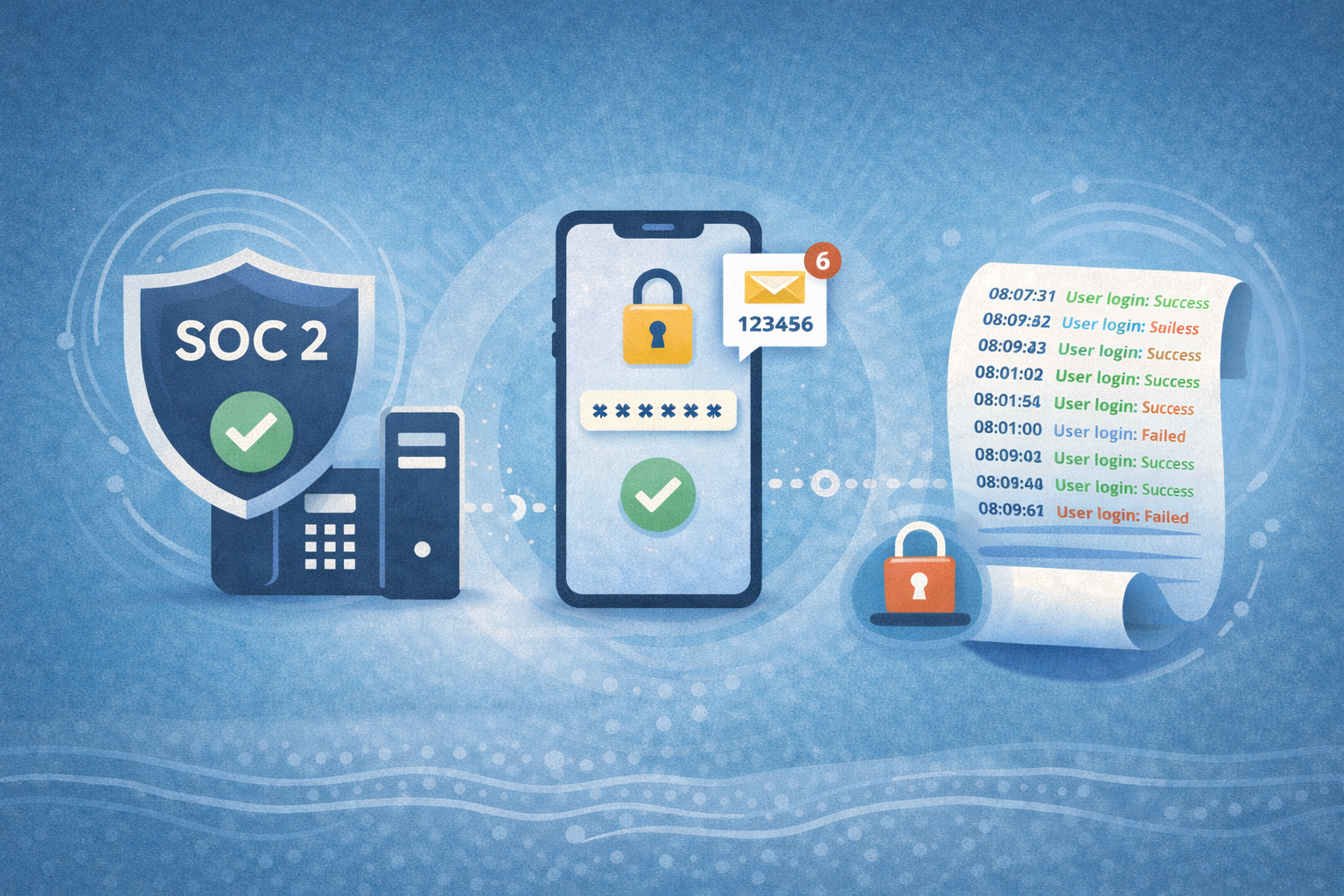
As fax platforms have evolved into integrated applications, the surrounding security model has become more complex. Each integration expands both capability and risk.
The systems that store, route, and integrate fax data need the same governance and scrutiny as any or PHI or PII system. Secure enterprise fax environments in 2026 share a common set of controls. Organizations should verify that their fax platform supports:
These controls, and the detailed checklist below, apply to OpenText Fax (RightFax) and all other enterprise fax platforms.
This guide is for informational purposes based on our implementation and advisory experience. It does not constitute legal or regulatory advice. Consult qualified professionals to determine the requirements that apply to your environment.
Vendor & Framework Alignment
Identity & Access Control
Data Protection
Audit & Legal Readiness
Integration Security
Monitoring & Operations
HIPAA establishes a baseline for protecting healthcare data, but it does not define a complete security program. The regulation requires safeguards such as access controls and encryption but leaves many operational details open to interpretation.
SOC 2 is a more comprehensive, industry-agnostic operational framework. It focuses on controls related to security, availability, confidentiality, change management, monitoring, and third-party risk. While SOC 2 certification is not required for healthcare organizations, alignment with its principles can help Covered Entities to show consistent operations and clear evidence during reviews.
However, SOC 2 Type II certification is critical for fax vendor selection. We consider it a hallmark of a mature, enterprise-grade fax vendor for the healthcare space.
Strong access control remains the most effective way to reduce risk. In short, the goal is to limit fax access to only verified users with clearly defined permissions.
Multi-factor authentication (MFA) is a universal best practice. It should protect all access points, including administrative consoles, user clients, and APIs. Password-only authentication is no longer considered sufficient for systems that handle sensitive data.
Most organizations benefit from integrating fax authentication with a centralized identity provider. This allows existing policies to apply automatically, and also simplifies onboarding and offboarding by keeping account management within a single identity system. Authenticator apps or push notifications usually suffice, although higher-risk or higher-permission roles might justify hardware keys or FIDO2.
Role-based access control complements MFA by limiting what users can do after authentication. Permissions should follow the principle of least privilege and clearly distinguish between end users, administrators, and audit or compliance roles.
Fax transmissions are inherently secure. Modern enterprise fax platforms also keep fax images and metadata secure at rest. Any legacy components that cannot meet current encryption standards should be isolated or retired as part of modernization efforts.
Retention policies also deserve attentionStoring fax records indefinitely may create unnecessary exposure, while overly aggressive deletion can create operational gaps. Most organizations strike a balance through policy-driven retention rules, automated deletion schedules, and controlled archival into secure EHR, ECM, or document management systems
Fax activity frequently becomes evidence in disputes involving patient care, billing, or contractual obligations. For that reason, auditability is as important as transmission security.
Comprehensive audit logs should capture who sent a fax, when it was transmitted, where it was delivered, and how it was processed. These logs must be tamper-resistant so records cannot be altered after the fact.
When correlated with identity data, telephony records, and EHR events, fax logs provide a clear chain of custody for sensitive information. That visibility strengthens compliance posture and simplifies investigations when questions arise.
Many significant security risks are not within the fax platform itself, but at its integration points. Shared identity and logging infrastructure makes fax activity easier to monitor and govern.
As we discussed earlier, centralized identity integration keeps auth policies consistent across applications and reduces the risk of orphaned accounts. Telephony infrastructure—including SIP trunks and gateways—should be secured and monitored for unusual volume or routing behavior.
Application integrations require equal attention. Service accounts should have narrowly defined permissions, API credentials should rotate regularly, and automated workflows should be reviewed periodically to prevent silent failures or unintended data duplication.
Security controls are only effective if they are monitored and tested.
Fax systems should feed authentication and activity events into centralized monitoring platforms alongside other infrastructure logs. This makes it easier to detect failed login attempts, unusual access patterns, or unauthorized permission changes.
Incident response planning should explicitly include fax systems. Misdirected transmissions, compromised accounts, and unauthorized archive access require clear procedures for containment and evidence preservation.
Regular operational reviews reinforce these controls. Periodic checks of access roles, MFA enforcement, retention settings, and log integrity help detect configuration drift before it creates risk.
Fax remains a dependable channel for sensitive information, but the surrounding platform requires the same governance as any other critical system. Strong identity controls, comprehensive audit trails, vendor oversight, and continuous monitoring keep fax environments secure and defensible.
Paperless Productivity® helps healthcare organizations and other regulated firms review enterprise fax deployments, identify control gaps, and develop practical improvement roadmaps. Reach out if you’d like to discuss your environment or learn what we’re seeing across large RightFax deployments in 2026.