
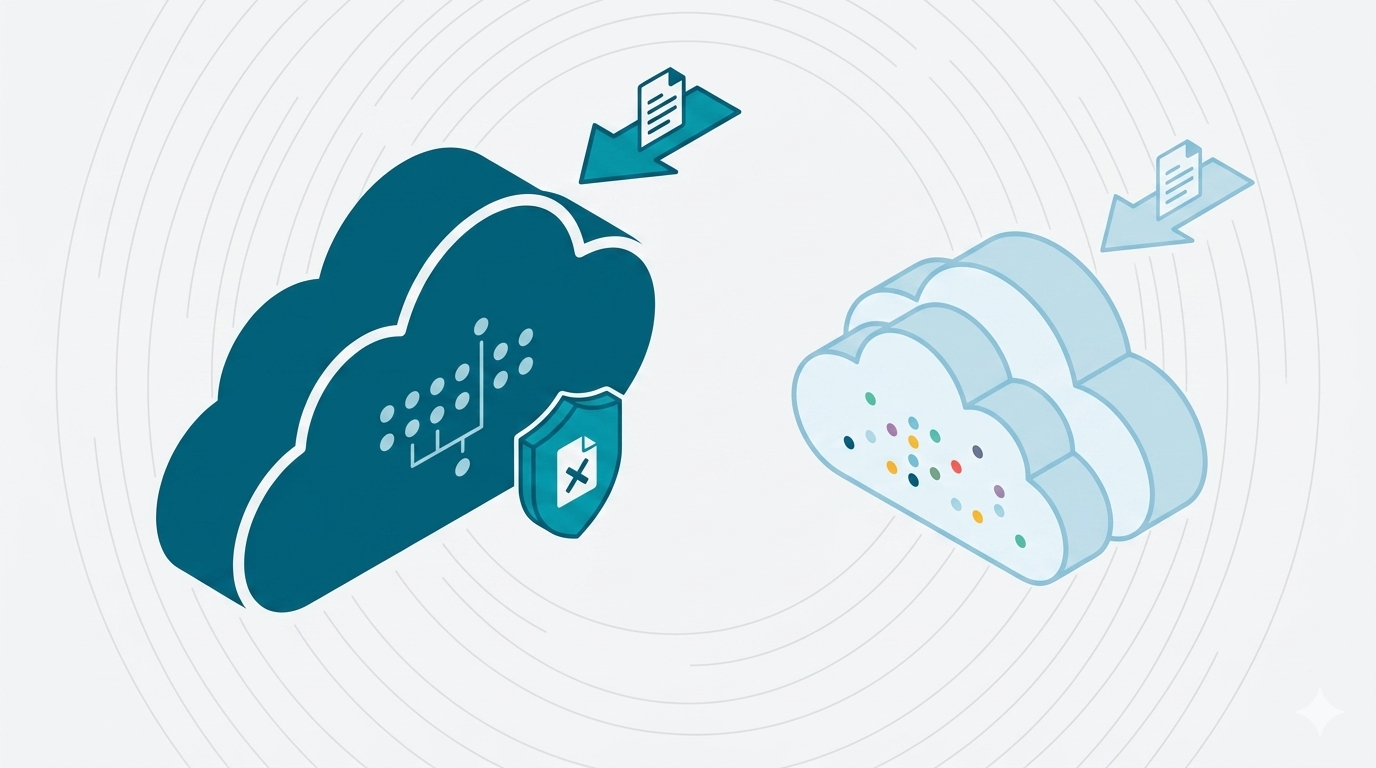
“Cloud fax” describes two architecturally distinct models. Generic public cloud fax services are multi-tenant SaaS products — fast to deploy, standardized, and priced per user, line, or page. Private deployments like Private Fax Cloud® run a dedicated, single-tenant environment on the full RightFax application stack, managed by a service provider.
Both eliminate on-prem hardware and may use IP telephony. Beyond that, they differ in terms of where your data resides, how deeply the platform integrates with clinical and business systems, how much visibility you have into audit trails and retry behavior, and who picks up the phone when something goes wrong.
For a broader look at how these models compare to on-premises deployments, see our fax architecture comparison.
Public cloud fax services store customer data on shared infrastructure. Separation between tenants is logical, not physical, as it relies on the vendor’s controls rather than dedicated resources. Most deliver inbound faxes via email with PDF attachments, which can complicate HIPAA compliance for PHI.
Private Fax Cloud uses dedicated infrastructure—no shared compute, shared storage, or shared networking. Fax transmission is point-to-point, with the same inherent security as analog fax. Received faxes are stored in an encrypted, centralized archive with role-based access control and full access logging. Permissions are configurable at the department, queue, or individual user level.
See our RightFax security and compliance for more details on security features.
This is frequently the deciding factor for healthcare organizations.
Public cloud fax platforms typically support email-to-fax, a user portal, and a REST API. Some offer EHR integrations, which are often limited to basic send and receive rather than automated routing. Complex clinical workflow or legacy desktop processes frequently require workarounds.
Private Fax Cloud uses the full RightFax integration library: Epic, Oracle Health, MEDITECH, Veradigm, ECM platforms, MFPs, print workflows, and most line-of-business applications. Inbound faxes can be routed automatically to the correct queue, department, or patient record. OCR and data extraction are built in, so fax content can be indexed, searched, and exported as structured data. Where an off-the-shelf integration doesn’t exist, the RightFax SDK covers virtually any remaining application.
Compliance in practice means demonstrating how PHI is handled, not merely claiming that it’s secure. That requires access controls, retention policies, and audit logs that your team can actually review. Proactive log review is one of the most commonly cited gaps in enforcement actions, as illustrated by the 2017 Memorial Healthcare Systems settlement, wherein a $5.5 million HIPAA resolution with HHS specifically highlighted the failure of audit controls.
Public cloud fax platforms provide audit trails, but visibility is limited to what the vendor surfaces in their portal. Retry behavior, carrier interaction, and routing logic are largely opaque, so post-incident investigation depends on the vendor.
Private Fax Cloud maintains full transmission history, access logs, and administrative logs — all queryable, all exportable. Retry status is visible in near-real-time, with user alerts when a retry is needed. Document routing between queues is tracked and audited. The Private Fax Cloud FAQ covers audit and access capabilities in more detail.
Public cloud fax abstracts telephony entirely. It’s a doubled-edged sword, as customers aren’t responsible for issues, but they aren’t able to see carrier interaction or retry logic, either. For better or for worse, the customer depends entirely on the provider to investigate and resolve incidents.
Private Fax Cloud manages both the fax platform and telephony end-to-end. Transmission parameters—batch size, timing, routing—are optimized by the RightFax engine to maximize delivery rates. Near-real-time status updates are available on inbound and outbound faxes, and there is a single point of contact for both platform and telecom issues.
Billing reflects this, too. Private Fax Cloud uses 6-second increment telecom billing after a flat 30-second rate, whereas many public cloud services have usage-based billing where retries count against your allotment (just as successful transmissions do).
Public cloud fax services are quick and inexpensive to set up. Enterprise-oriented vendors may offer volume-based custom contracts, but usage-based billing remains the norm.
Private Fax Cloud has no per-user, per-line, or per-page charges. The model is upfront costs plus a monthly subscription, with usage-based telecom billed as a 30-second minimum plus 6-second increments thereafter. The cost advantage grows with volume.
ROI timelines depend on your current environment, volume, and workflow complexity—all of which are modeled as part of the planning phase. As a general reference point, most organizations see payback in 3–12 months.
Public cloud fax offloads infrastructure management entirely, but admin capabilities are correspondingly limited: basic user and queue management, standard reporting, and constrained customization. Support escalation paths can be unclear when the fax provider and telecom provider are separate vendors.
Private Fax Cloud offloads infrastructure, telephony, patching, monitoring, and failover to our team, but your staff can retain advanced admin capabilities. There is one vendor and one point of contact for platform and telecom. See our hosted RightFax and managed services guide for more on what that relationship looks like.
The right choice depends on a handful of criteria that vary significantly by organization. This table captures how we think of the comparison.
| Attribute | Private Fax Cloud® | Public Cloud Fax |
| Fax volume | High or variable | Modest, predictable |
| Pricing model | Flat subscription + 6-second telecom increments | Usage-based; retries count against allotment |
| EHR integration | Automated queue routing to correct department or patient record | Basic send/receive; email delivery of inbound faxes |
| PHI handling | Point-to-point transmission; encrypted single-tenant archive | Logical tenant separation; inbound typically via email attachment |
| Audit visibility | Full transmission, access, and admin logs: queryable and exportable | Limited to what vendor surfaces in portal |
| Retry transparency | Near-real-time status; user alerts on retry | Often delayed; carrier interaction opaque |
| Telecom ownership | Single vendor for platform and telecom | Fax and telecom providers often separate |
| Infrastructure management | Fully managed: patching, monitoring, failover handled | Fully managed |
| Admin depth | Advanced: routing rules, permissions, queue management | Limited — basic user and queue management |
| Speed of deployment | Typically live in a week or less | Fast (often same day) |
If your org identifies with many or most of the priorities below, then Private Fax Cloud is generally the right fit.
For health systems migrating from on-prem RightFax, Private Fax Cloud preserves EHR integrations, eliminates hardware management, and maintains the compliance controls the environment requires. For community hospitals and smaller organizations with limited IT staff, the managed model removes operational burden without sacrificing auditability. For ambulatory groups and physician practices, public cloud fax may be adequate at low volume…but growing referral volume can still strain email-based inbound delivery and limited routing.
High-volume, multi-department routing and strict audit trail requirements consistently favor private cloud architecture in these sectors. Data isolation and retention control are fundamentally better supported in a single-tenant environment.
The right architecture depends on your volume, integration requirements, compliance practices, and internal capacity to manage fax infrastructure. If you’d like help thinking through the trade-offs for your specific environment, contact us for a consultation.