
Paperless Productivity
Fax isn’t going anywhere in healthcare, but today, it’s easily automated in ways that weren’t even on the table a few years ago. Faxes keep on arriving as before, but the difference is what happens when they arrive.
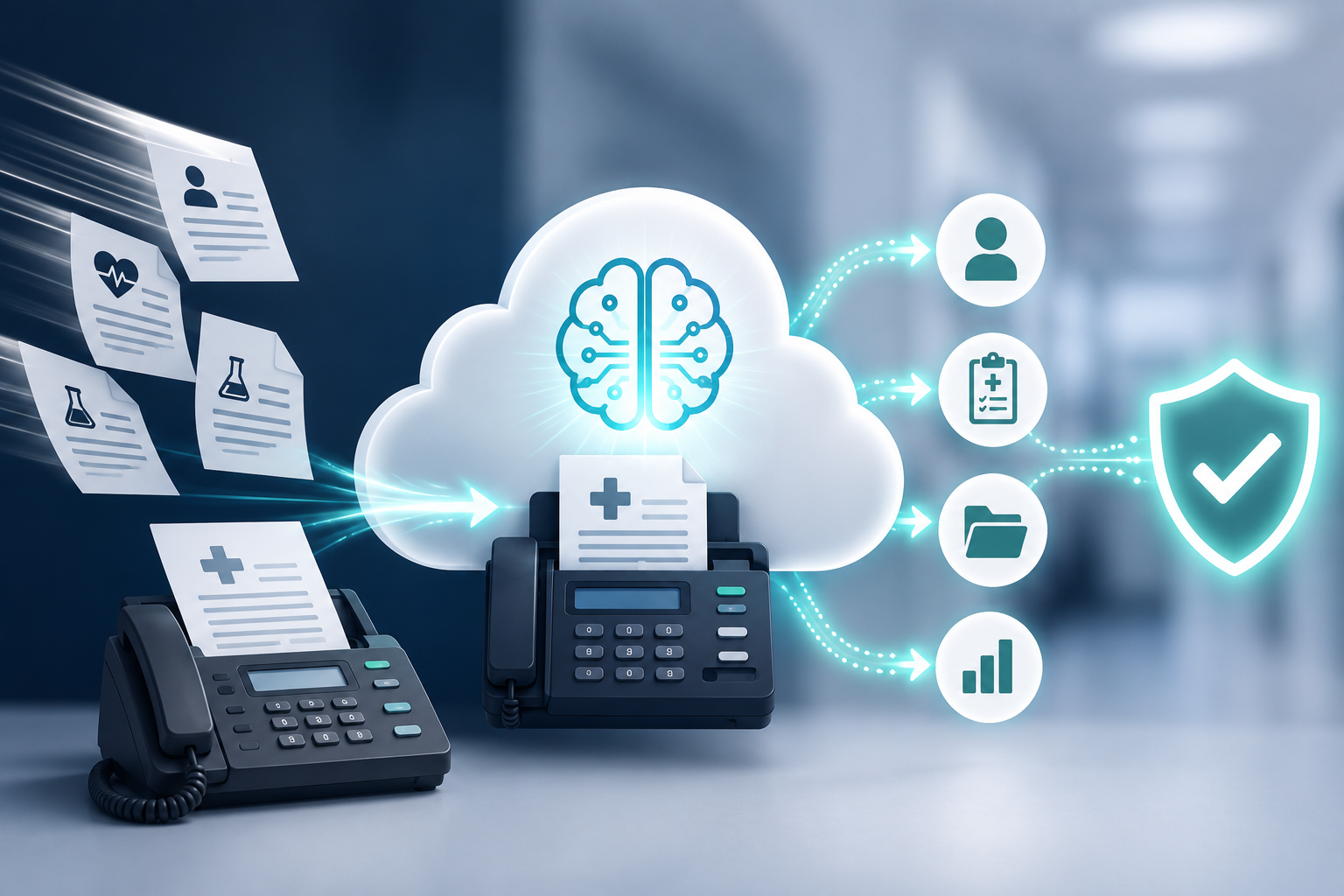
For years, that meant a person: printing, sorting, reading, and re-keying. Now, that work increasingly happens before anyone touches the document. Refined OCR engines work with current-generation AI models to transform messy, inconsistent documents into structured outputs all within HIPAA-ready fax infrastructure. High-volume inbound faxes get read, understood, and routed with far less manual handling.
OCR and AI are often talked about as separate technologies. In an automated fax workflow, they’re best pictured as two layers of a single mechanism:
It’s not OCR alone, and not AI alone, but a single read–understand–act sequence that replaces most of what used to be manual review. That AI layer runs inside the same governed, auditable fax environment as the rest of your infrastructure—not as a bolt-on tool—so each document is still handled and governed as PHI. It simply happens faster.
Visit our read–understand–act overview for a closer look at the core of workflow automation in the AI era.
Nearly every fax belongs in one of two places: an EHR record or a human’s queue. The key to worthwhile automation is knowing the difference.
For decades, the most common request we’ve heard about fax-to-EHR workflows has been some version of: “Can the fax just become structured data in the chart, without someone typing it in?”
For far too long, the candid answer was “not reliably.” Document quality varied too much, and OCR alone couldn’t guarantee clinical standards for accuracy.
That’s changed. When a document is clear and well-structured, OCR and AI together can validate it against expected fields and output it as an HL7 message directly into the EHR—Epic, Oracle Health (Cerner), and Veradigm (Allscripts), and others—instead of a generic queue.
Humans still receive everything that’s ambiguous, incomplete, or in need of a judgment call. What’s different is the order it arrives in. One of the most common concerns we hear is that schedulers spend a disproportionate amount of time figuring out what’s urgent. A routine refill and an urgent referral can land in the same stack minutes apart, and someone has to read both before knowing which one to handle first. More time deciding means less time acting.
Automation removes that step. AI flags urgency during the read–understand–act sequence, so the fax reaches the scheduler already ranked, not just in arrival order. The scheduler still makes the call and still talks to the patient, but they don’t lose time figuring out the urgency and sorting through documents themselves.
None of this requires abandoning fax or forcing referring providers onto a new system. The automation happens after the fax arrives, on infrastructure you already have, with the same compliance posture you already maintain.
This kind of OCR- and AI-assisted routing is increasingly built into Private Fax Cloud® deployments, where it runs alongside the same managed, HIPAA-aligned infrastructure rather than as a separate system to maintain.
Reading and routing inbound faxes faster is the immediate win, but it’s really one piece of a broader shift toward automated, responsive patient communication — one where status updates, callback workflows, and follow-up don’t depend entirely on someone remembering to make a call.
HIPAA-ready fax OCR and automation aren’t a wholesale replacement for how your organization works today. They plug into it, reducing manual handling from the moment a document arrives.
If backlog, response time, or staff capacity around inbound fax is a recurring problem, it’s worth a conversation about where automation would have the most impact for your workflows. Contact us to talk to a senior solutions engineer about what fax automation could look like for your organization.