
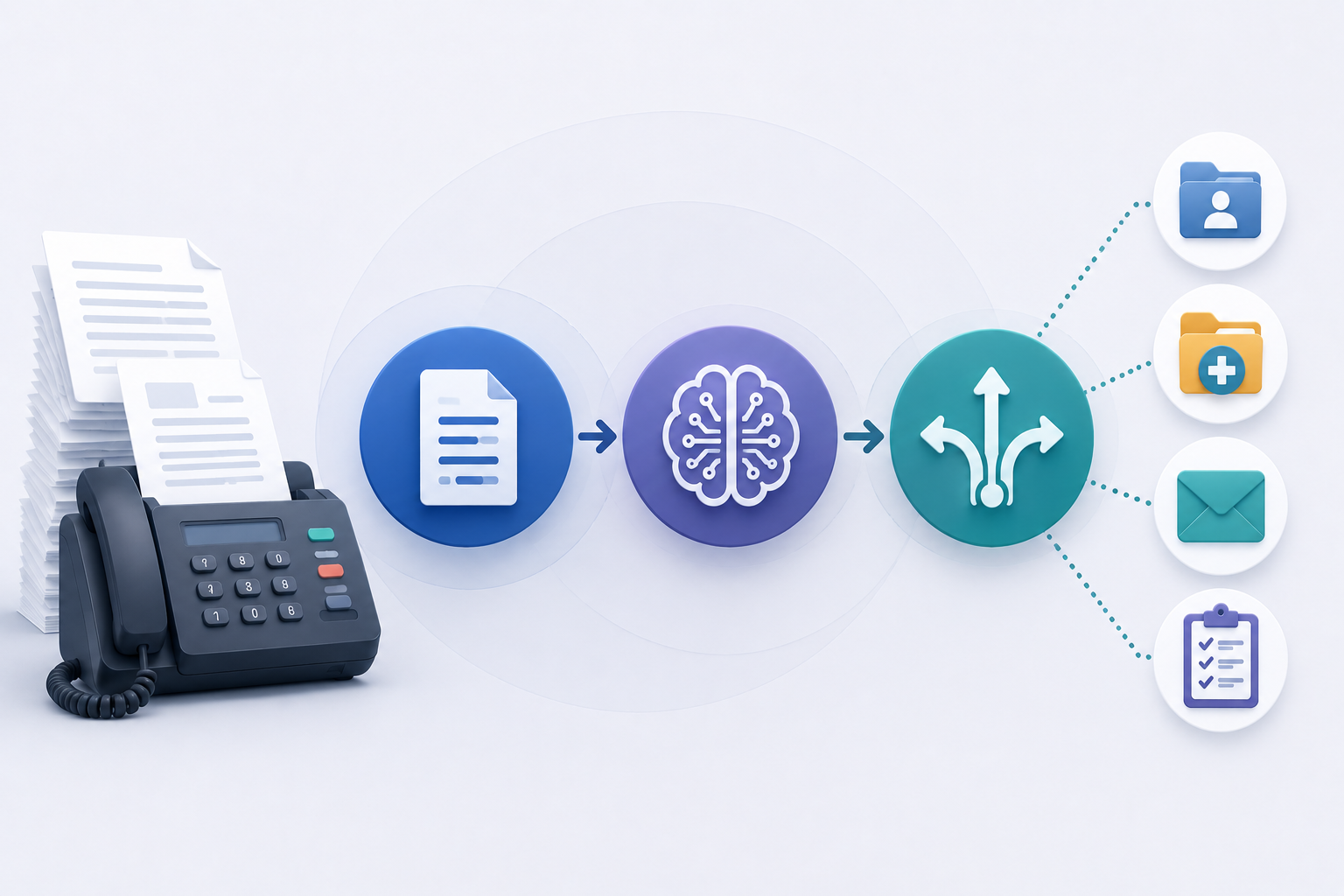
Paperless Productivity
A fax can be read, judged for urgency, and routed to the right queue before a human opens it.
It might sound like black-box software pulling criteria out of thin air, but that couldn’t be farther from the truth. Read–understand–act is a precise, repeatable automation technique that scales smoothly while respecting enterprise safeguards and human judgment.
We’ll cover how this approach outperforms standalone OCR or AI, then look inside each step to understand how it “thinks” about your most critical faxes.
It’s tempting to think of OCR and AI as competing technologies, but in practice, they solve different problems.
A weak reading step introduces errors that no amount of downstream reasoning can fully correct. A weak understanding step wastes an otherwise perfect read, since a well-digitized document routed on guesswork is barely better than a stack of paper.
All three steps are built to work together, each building on the last, avoiding the weak links that arise when bolt-on tools are chained together.
Every fax arrives as a picture of text, not an actual text document. Nothing can happen until this image becomes text that a computer can work with.
Optical character recognition matches the shapes on a page against known letter forms. When a fax is clean, typed, and well-aligned, this step is close to instant and close to perfect. The output is a block of text sitting in roughly the same layout as the original page.
But fax images are rarely crystal-clear. Some are photocopies of photocopies; others have handwritten notes crossing printed lines. This is normal and expected in a clinical setting.
Enterprise-level OCR tools address these challenges in three ways:
Fax-specific capture software is tuned for exactly this kind of noise. It not only minimizes human intervention, but even more importantly, it delivers accurate information to the next step in the workflow.
Extracted text is only useful when someone—or something—determines what needs to happen next. For decades, computers have been able to answer that question under specific circumstances, but deviations have typically required human judgment. Only in very recent years has automated understanding become a reality.
What does it take for AI to understand a fax?
Pre-AI, the main strategy was to match template features. If it saw a) a name in the top-right box, b) a date of birth two lines below it, and c) a diagnosis code in a fixed position, then it matched the format of a prior authorization, and was labeled as such. That’s still a good approach in high-volume, low-variation situations, but it’s too rigid for day-to-day use in most offices.
Today, LLMs fine-tuned on document content effectively read like a human rather than seeking patterns in fixed spots. They do this in many ways, the most powerful of which include:
That last point bears emphasizing. Urgency is usually implicit in language, not explicit in a template, so it was virtually impossible for older tools to judge urgency on the fly.
AI-powered document triage means people see genuinely urgent information automatically—no need for their colleagues to comb through hundreds of incoming documents first.
Document understanding and triage are a means to the end goal of quick, correct action.
The system routes the document according to your business rules, weighing subject matter and urgency the way a trained scheduler would.
That confidence threshold decides whether a fax gets handled automatically or handed to a person. That’s the safeguard that keeps the system trustworthy at scale.
A common failure mode in document automation is stitching together separate products for each step: one vendor for capture (reading), another for the AI layer (understanding), a third system for routing (action). Every handoff between those systems is an opportunity for documents and their context to slip away.
With Private Fax Cloud®, everything lives inside the same managed environment as the rest of your fax infrastructure. There’s no separate export step, no second system to patch and monitor, and no invisible gap between receiving and handling a document. The read–understand–act sequence is one continuous process on infrastructure your team already trusts.
A good read–understand–act implementation lets staff spend less time sorting and more time on work that actually needs a human. Urgent items stop competing with routine ones for attention in a single undifferentiated stack. And many documents automatically become structured data, without someone re-typing what’s already been read.
If this sounds more sustainable than your current document backlog or staffing demands, then contact us to discuss how a read–understand–act workflow might apply to your own document mix.